
For Immediate Release: August 12, 2026
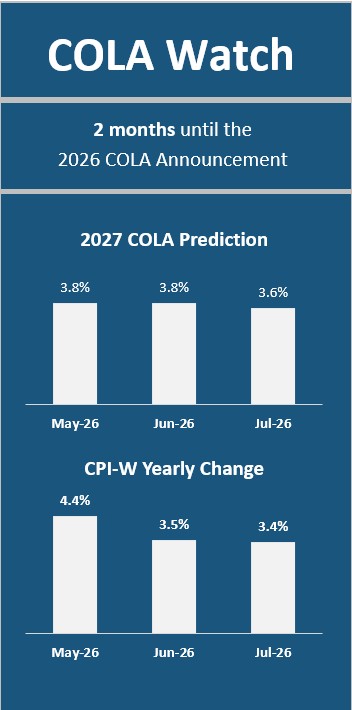
TSCL predicts that Social Security’s 2027 Cost of Living Adjustment (COLA) will be 3.6 percent, which is 0.8 percentage points higher than this year’s COLA of 2.8%. If TSCL’s projected 2027 COLA took effect today, average benefits would rise by $69.75, from $1,937.53 to $2,007.28.
The Social Security Administration will announce the official 2027 COLA on October 14th. The government calculates the COLA by taking the average yearly change in the Consumer Price Index for Urban Wage Earners and Clerical Workers (CPI-W) for July, August, and September. The July CPI-W, released today, came in at 3.4%.
If TSCL’s projection holds, the 2027 COLA will be the highest in four years. The COLA was 2.8 percent in 2026, 2.5 percent in 2025, and 3.2 percent in 2024. It was 8.7 percent in 2023, as post-COVID inflation reached its peak.
Inflation has remained high throughout the 2020s. From 2010 to 2019, the COLA (and inflation, as measured by the CPI-W) averaged approximately 1.4 percent. From 2020 to 2025, it averaged 3.7 percent.
Key Insights:
- The TSCL COLA projection is higher than last year because inflation is higher than last year. The CPI-W, the index used to calculate the COLA, has risen at an annual rate of more than 3 percent since the March 2026 release (February data). In 2025, the CPI-W peaked at 3 percent.
- The current CPI-W yearly change is 3.4 percent, which is 0.2 percentage points lower than TSCL’s projection. This means our model expects inflation to rise slightly over the next two months.
- Energy markets and oil prices will play an important role in influencing the 2026 COLA. As of August 6th, oil prices currently sit approximately 24 percent higher than this time last year, and fuel prices have downstream effects on inflation because they raise prices for producing and transporting goods, costs that get passed onto consumers.
TSCL Executive Director Shannon Benton says…
- “One of the biggest challenges this year has been the sharp swings in inflation. It started at 2.2% in January, climbed to 4.4% in May, then fell to 3.5% in June. Fortunately, our model is designed not to overreact to these swings, keeping our COLA projections relatively steady.”
- “One of the biggest wild cards in this year’s forecast has been inflation’s volatility. It started the year at 2.2%, then surged to 4.4% by May before falling back to 3.5% in June. That kind of instability can throw off forecasts, but our model is designed to avoid chasing every spike and dip, which has kept our predictions on a relatively steady course.”
- “Seniors don’t experience inflation as a percentage on a chart. They experience it at the grocery store, at the pharmacy, in their insurance premiums and when they pay the rent. That’s why the size of the COLA matters, but so does how accurately it reflects their real-world expenses.”
- “Frankly, it’s infuriating that seniors must wait for a COLA to catch up with prices that have already driven up their grocery bills, housing costs, healthcare expenses and insurance premiums. A higher COLA is welcome, but seniors shouldn’t have to lose purchasing power year after year before Washington acknowledges what they’re experiencing.”
About TSCL:
The Senior Citizens League (TSCL) is one of the nation’s largest nonpartisan seniors’ groups. Established in 1992 as a special project of The Retired Enlisted Association, our mission is to promote and assist our members and supporters, educate and alert senior citizens about their rights and freedoms as U.S. citizens, and protect and defend the benefits seniors have earned and paid for. TSCL consists of vocally active senior citizens concerned about the protection of their Social Security, Medicare, and veteran or military retiree benefits. To learn more, visit https://seniorsleague.org/about-us/.
About the TSCL COLA Model:
TSCL issues a new prediction of the next COLA for Social Security each month using our statistical model. The model incorporates the Consumer Price Index, the Federal Reserve interest rate, and the national unemployment rate to make its predictions. The model’s predictions update throughout the year, adjusting in response to economic conditions. For additional information about the model, contact Alex Moore, TSCL’s statistician, at amoore@tsclhq.org.
We released a new version of the model, v1.2, in January 2025. The new version updates the model’s data handling, processing data according to the federal fiscal year rather than the calendar year. The new model also reduces each prediction’s reliance on previous predictions made throughout the federal fiscal year.
Contact Information:
- Shannon Benton, Executive Director: sbenton@tsclhq.org; 703-548-5568
- Alex Moore, Statistician: amoore@tsclhq.org; 571-349-2658
