For Immediate Release – June 10, 2026
Today, TSCL published its 2026 Senior Survey. This research surveyed 904 seniors, asking them questions about their finances, satisfaction with Social Security and Medicare, and support for various policies aimed at strengthening the benefit programs. The report is free to download HERE.
TSCL estimates that 24.6 million seniors, or 44 percent of the country’s approximately 55.8 million retirement-age population, depend on Social Security for 100 percent of their income. That’s up from 39 percent, or 21.8 million, last year. This leaves many seniors in the lurch, with 54 percent living on less than $2,000 a month. For reference, average rent for a one-bedroom apartment in the U.S. runs more than $1,500 a month.
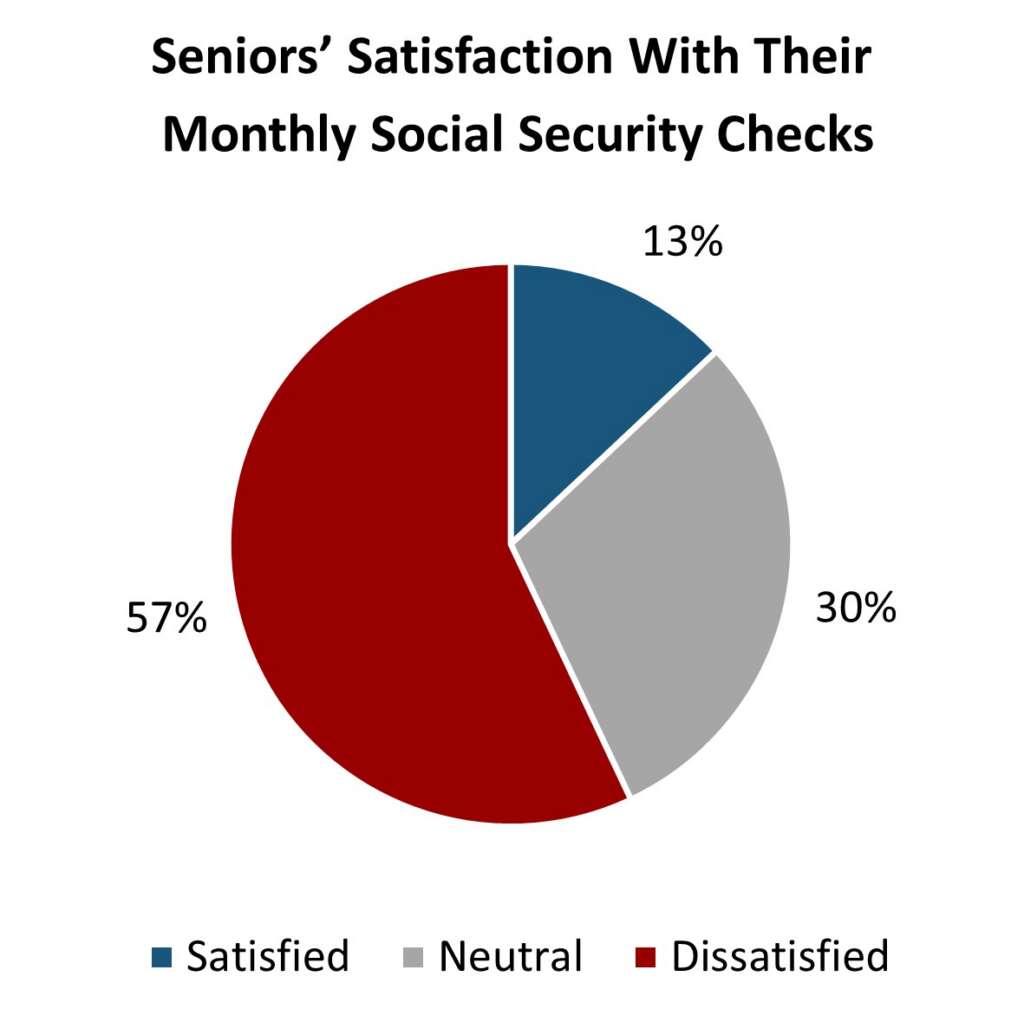
Most Seniors are frustrated with their Social Security benefits. Almost three-fifths of seniors who completed the survey said they were dissatisfied with the amount they receive from their monthly Social Security checks. Meanwhile, 89 percent said they felt the 2026 COLA of 2.8 percent was too low and that their benefits grow more slowly than inflation.
Benefit reform is a top priority for seniors. Nearly all respondents (89 percent) said reforming Social Security and Medicare should be a top priority for the Presidential Administration and Congress.
Key Insights
• Most seniors think 2025’s inflation was much higher than the government’s estimate. The 2026 COLA, which is supposed to adjust Social Security checks to keep pace with inflation that occurred in 2025, was 2.8 percent. When TSCL asked seniors how much they thought inflation was in 2024 based on their economic experiences, 59 percent thought inflation was 3 percent or higher.
• Seniors want an act of Congress to strengthen future COLAs. To address benefits that have fallen behind inflation, 89 percent of seniors favor Congress passing a one-time stimulus payment to make up the difference. Additionally, 75 percent want to see Congress guarantee a minimum COLA of 3 percent and 65 percent want to see COLAs calculated using a price index that’s specifically tailored to seniors’ economic experiences. The COLA is currently calculated with the Consumer Price Index for Urban Wage Earners (CPI-W), rather than the Consumer Price Index for the Elderly (CPI-E).
• Aging Americans believe the U.S. should not pay more for drugs than other developed countries. In May 2025, President Trump signed an executive order requiring that pharmaceutical companies bring down prescription drug prices in the U.S. market to match the lowest price offered in other developed countries. A total of 88 percent of seniors agree with the policy, with support consistent across political affiliations.
TSCL Executive Director Shannon Benton says…
• “Another year, another COLA, and the story stays the same. Seniors keep telling us they’re getting less than they hoped for on their Social Security and Medicare benefits, and Congress keeps doing little to fix the problem.”
• “Social Security has always served as a thin line between dignity and poverty for older Americans and the disabled, but that line has become thinner than ever. Nearly half of seniors rely on Social Security for all their income, and that figure is rising over time. We need to protect today’s seniors first, and then we need to pass legislation that strengthens Social Security for future generations.”
• “TSCL has long called for a senior stimulus payment, and the time is now. A one-time payment would provide immediate relief for beneficiaries and show good faith as negotiations begin to address the program’s looming insolvency in the early 2030s.”
About TSCL:
The Senior Citizens League (TSCL) is one of the nation’s largest nonpartisan seniors’ groups. Established in 1992 as a special project of The Retired Enlisted Association, our mission is to promote and assist our members and supporters, educate and alert senior citizens about their rights and freedoms as U.S. citizens, and protect and defend the benefits seniors have earned and paid for. TSCL consists of vocally active senior citizens concerned about the protection of their Social Security, Medicare, and veteran or military retiree benefits. To learn more, visit https://seniorsleague.org/about-us/.
About the 2026 Senior Survey:
TSCL surveyed American seniors over the age of 62 who were eligible for their Social Security benefits. Overall, 904 participants provided complete enough data to use in the study. TSCL distributed the survey from January to March 2026, then analyzed the results from April to May 2026. The full findings of the study are available for free here.
Contact Information:
• Shannon Benton, Executive Director: sbenton@tsclhq.org; 703-548-5568
• Alex Moore, Statistician amoore@tsclhq.org; 571-374-2658